


Plantronics Savi W720 Wireless Headset System
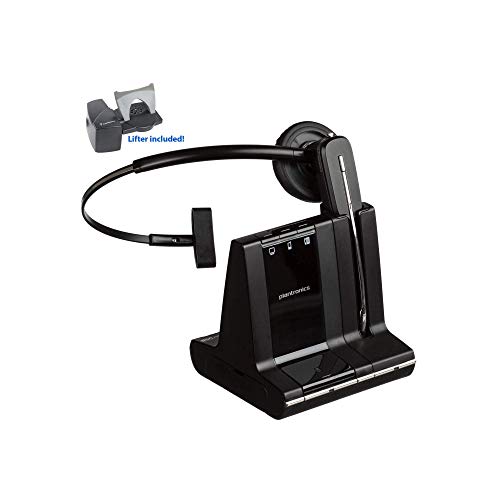
The Plantronics Savi W720 is our triple-connectivity wireless headset system built for professionals who manage calls across desk phone, PC softphone, and mobile device simultaneously. Its DECT 6.0 wireless technology delivers secure, interference-free audio up to 350 feet from the base, giving you freedom to move around the office without dropping calls.
We designed the W720 with over-the-head binaural ear cushions to block out background noise in busy environments, while our adaptive power system optimizes battery life and talk time based on how far you roam from the base. The included touchscreen base puts call control and device switching at your fingertips, so you can answer, mute, and switch between three audio sources without reaching for your phone or keyboard.
Triple Connectivity & DECT 6.0 Technology
DECT 6.0 Wireless Range & Security
The Savi W720 operates on DECT 6.0 frequency, separate from crowded Wi-Fi and Bluetooth bands, which eliminates the dropouts and interference common in open offices. You get a clean 350-foot range from the base station—enough to walk to the break room, conference room, or colleague’s desk without ending your call.
DECT 6.0 also provides 128-bit encryption, so your conversations stay private even in shared workspaces. Our adaptive power system continuously monitors your distance from the base and adjusts transmission strength to extend battery life. When you’re at your desk, the system conserves power; when you move farther away, it boosts signal strength to maintain clarity.
Triple-Device Connectivity
We built the W720 to solve the device-juggling problem that customer service reps, IT help desks, and busy executives face daily. The base station connects to your desk phone via RHL-10 handset lifter or EHS cable, to your PC via USB, and to your mobile phone via Bluetooth—all at once.
You can have calls active on all three lines and switch between them with a single button press on the headset or base. When a call comes in on your desk phone while you’re on a PC softphone call, the W720 alerts you with a tone and lets you put one on hold to answer the other. The touchscreen base shows which line is active, which are on hold, and displays caller ID when available, giving you full visibility into your call queue without glancing at three separate screens.
Binaural Design & Noise Canceling
The over-the-head binaural configuration covers both ears with leatherette cushions, creating passive noise isolation that helps you focus on the caller’s voice even in high-traffic areas. Our noise-canceling microphone sits on an adjustable boom that you can position precisely at the corner of your mouth, where it captures your voice while filtering out keyboard clicks, coworker conversations, and HVAC hum.
Wideband audio support delivers frequencies up to 6800 Hz—twice the range of traditional telephony—so voices sound natural and intelligible. We’ve tuned the speaker drivers to emphasize mid-range frequencies where human speech lives, reducing listener fatigue during back-to-back calls. The cushions rotate slightly to match the angle of your ears, distributing pressure evenly for all-day comfort.
Other Savi Series Wireless Headsets



Rated 4.8 by verified buyers
Common Questions About the Savi W720
Yes, the W720 is certified for Microsoft Teams and works seamlessly with Zoom, Cisco Webex, and other UC platforms. The USB connection to your PC registers the headset as a standard audio device, so call controls—answer, end, mute—function natively within those applications. You can manage softphone calls on your PC while still connected to your desk phone and mobile via the same headset.
Press the multifunction button on the headset or tap the active line icon on the touchscreen base to cycle between connected devices. When a new call comes in on a different line, the headset emits a ringtone and the base screen highlights that line. You can put the current call on hold and switch to the incoming call with one button press. The base displays which lines are active, on hold, or idle at all times.
The HL10 is a mechanical arm that physically lifts your desk phone handset when you answer a call remotely, simulating the action of picking up the handset yourself. An EHS cable provides an electronic signal to compatible desk phones, answering the call without any moving parts. EHS is cleaner and more reliable if your phone model supports it, but the HL10 works with nearly any desk phone. We include the HL10 in the box; EHS cables are sold separately and model-specific.
Yes, the binaural over-the-head design provides passive noise isolation by covering both ears with cushioned cups. The noise-canceling microphone filters out ambient sounds like keyboard typing, coworker conversations, and HVAC noise, focusing on your voice. Users in call centers and busy support desks report that callers on the other end don’t hear background chatter, and the dual-ear configuration helps you concentrate on the conversation without distractions.
The W720 delivers up to six hours of continuous talk time on a full charge. Adaptive power management extends that runtime when you stay closer to the base by reducing transmission strength. When the battery nears depletion, the headset beeps and the base screen warns you, giving time to finish your call or dock for a recharge. The battery is user-replaceable—you can order a spare and swap it yourself without returning the unit for service.
No, the W720 uses DECT 6.0 wireless technology, which operates on the 1.9 GHz band in North America—completely separate from the 2.4 GHz and 5 GHz bands used by Wi-Fi and Bluetooth. This separation eliminates interference and dropouts common in offices with dense wireless traffic. DECT 6.0 also provides 128-bit encryption, ensuring your calls remain private and secure.
Yes, the W720 base supports conference mode, allowing you to subscribe up to three additional W720 headsets to a single base station. All subscribed headsets join the same call, making it easy for small teams to participate in training sessions or collaborative support calls. Each headset operates independently for mute and volume, but all share the same audio stream from the base.